
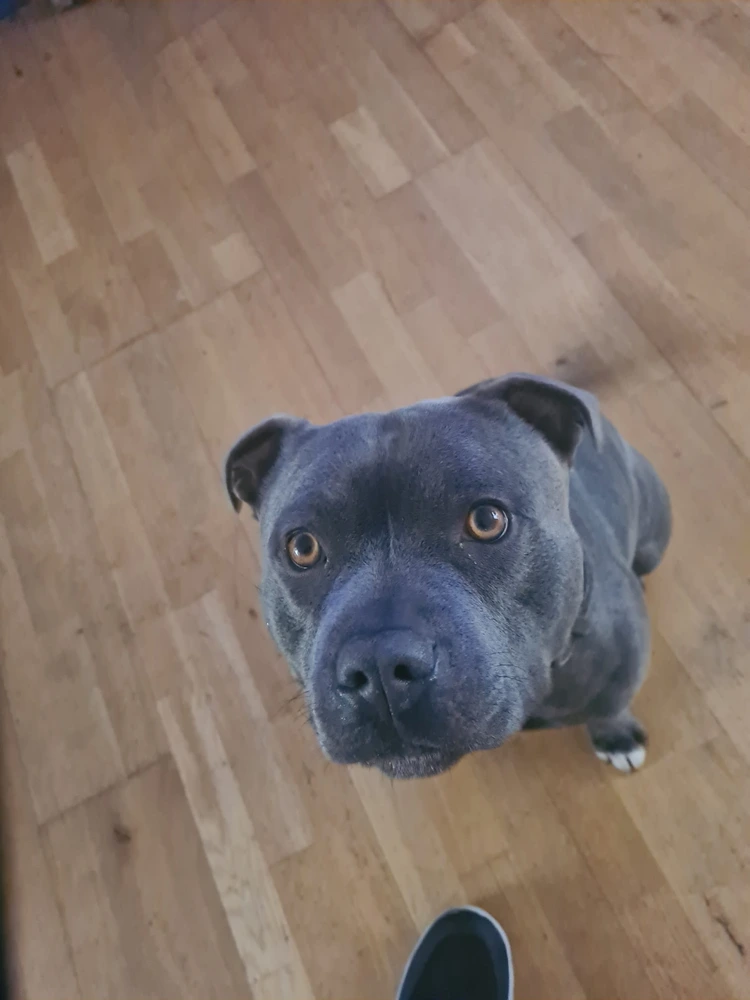
09Rehabilitation outcomeBluStaffie · arousal, reactivity and touch conflict
Blu's progress depended on recognising how quickly ordinary interaction could tip into unsafe arousal.
Case stageRehabilitation outcome
ProfileStaffie · arousal, reactivity and touch conflict
01 · The presenting picture
Blu's programme addressed fixation, lunging, barking, unreliable recall and difficulty remaining regulated around everyday stimulation.
The handover also recorded significant conflict around touch and a rapid shift from play into predatory-style arousal, making strict separation from children and close observation of body language essential.
02 · What the audit identified
Lip licking, changes around the eyes and body stiffness were important early indicators that contact or excitement had become too much.
Blu could develop tolerance around neutral dogs, but that progress did not justify uncontrolled contact, forced affection or relaxation of household safety rules.
03 · The Canine UK strategy
- Build lead manners, recall and core obedience across varied environments.
- Reduce fixation and reactivity through earlier communication and controlled exposure.
- Use structured rest and play to keep arousal within a workable range.
- Develop tolerance around neutral dogs without forcing sociability.
- Create explicit child-safety, touch and home-management rules for transfer.
04 · Rehabilitation outcome
- Blu's handover recorded improved lead manners, reduced reactivity, stronger recall and a clearer response to core obedience.
- He worked with multiple handlers and across varied environments, building stamina and impulse control progressively.
- The outcome remained management-led: the family received clear instructions around children, touch, rest, resources and early signs of escalation.
05 · Owner transfer and maintenance
The owner plan required separation from children, careful monitoring of touch, early reduction of over-arousal, structured rest and continued advocacy around unfamiliar dogs.