
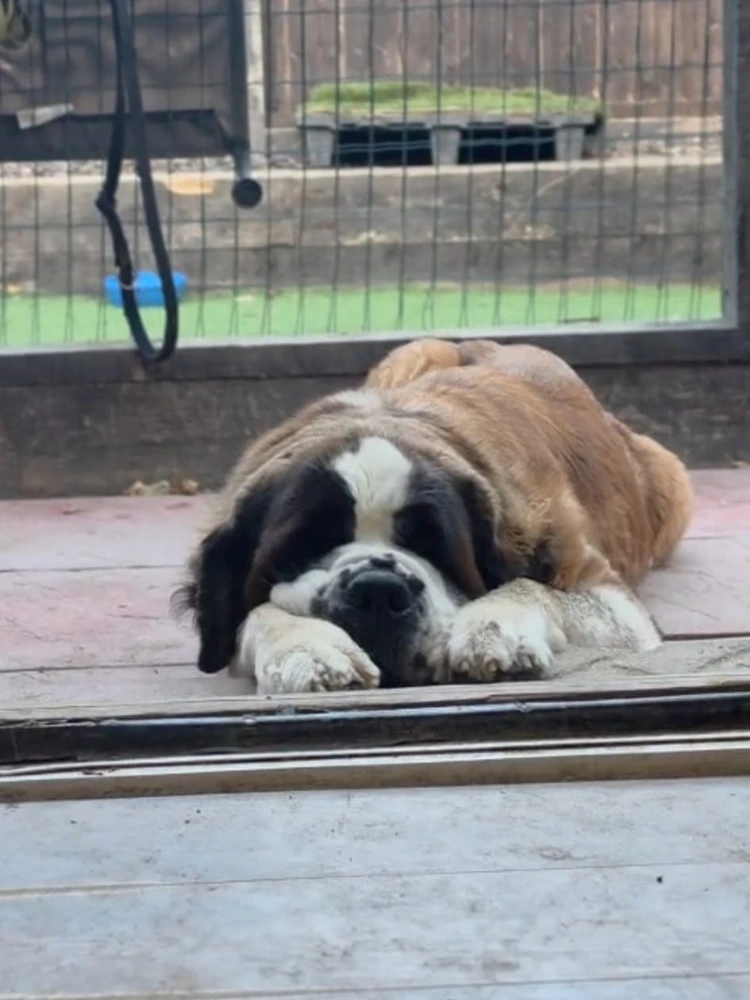
17Behavioural AuditDelilah4-year-old St Bernard · environmental stress and lead frustration
Delilah's size made careful interpretation important: powerful behaviour did not automatically mean offensive aggression.
Case stageBehavioural Audit
Profile4-year-old St Bernard · environmental stress and lead frustration
01 · The presenting picture
Delilah was adopted through rescue and arrived with limited reliable history. At home she barked at people passing a see-through front gate and became increasingly unsettled during longer veterinary visits.
She could join group walks, but lead frustration, over-physical play with small dogs and moments of fixation required careful assessment. The family wanted a less stressed dog, better recall and more freedom together.
02 · What the audit identified
During controlled interactions Delilah showed appropriate communication and good recovery. She disengaged when corrected by a smaller dog and offered a play bow, while remaining neutral around other appropriate dogs.
A brief stiffening and heavy two-paw pounce during play highlighted the need to monitor arousal and size mismatch. Eye, dental and digestive concerns were also referred for veterinary review because discomfort could affect tolerance and engagement.
03 · The Canine UK strategy
- Replace poorly fitted head-halter management with clearer, safer lead communication.
- Teach a gate-barking protocol and place behaviour for predictable household arrivals.
- Build recall and settling while supervising play according to size and arousal.
- Use calm exposure before a planned holiday period rather than relying on avoidance.
- Separate health questions from behavioural assumptions and obtain veterinary input.
04 · Recommended pathway
- The audit supported a confidence and regulation pathway rather than labelling Delilah as generally aggressive.
- Training priorities were recall, calmness, lead communication and more deliberate management of the front boundary and play.
- Her positive social recovery was treated as useful evidence while the moments of fixation remained part of the risk picture.
05 · Owner transfer and maintenance
The family needed to reduce over-arousing interaction, practise predictable gate and place routines, supervise size-mismatched play and continue health follow-up.