
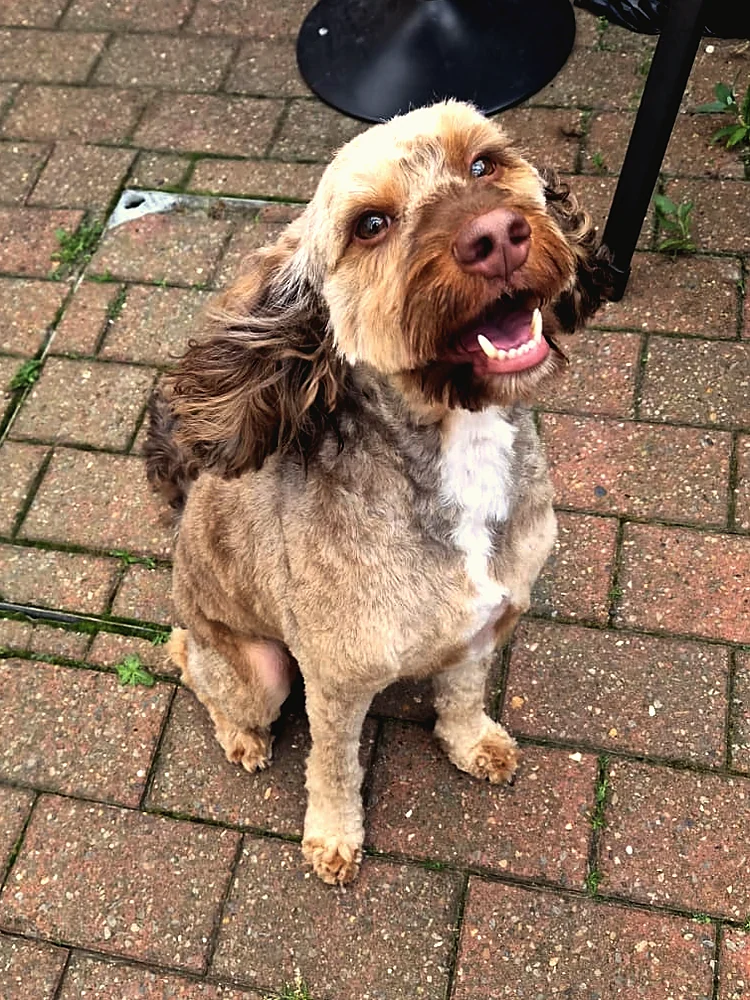
13Active rehabilitationOscar2-year-old Cockapoo · bite history and spatial resource guarding
Oscar's progress could not be judged only by how he behaved for the trainer he had bonded with.
Case stageActive rehabilitation
Profile2-year-old Cockapoo · bite history and spatial resource guarding
01 · The presenting picture
Oscar entered residential rehabilitation with a history of multiple bites, including a serious bite to a family member that required hospital treatment and surgery.
His guarding was centred less on food or toys and more on space, access to himself and control of his environment. Basic lead pressure could produce crocodile rolling, resistance and attempts to bite when he felt challenged.
02 · What the audit identified
Oscar had learned that conflict could remove pressure and allow him to control access. Inconsistent routine, limited regulated rest and unmet fulfilment needs also contributed to the environment in which those behaviours were rehearsed.
His warning sequence included a harder expression, body stillness, a tight mouth, repeated lip licking and deliberate withdrawal. Reading the whole picture before escalation was essential.
03 · The Canine UK strategy
- Build lead manners, recall, off-lead obedience, leave-it and clearer responses to handling.
- Use structured crate rest, a supervised house lead and consistent boundaries around guarded space.
- Introduce muzzle management as an additional safety layer during owner transfer.
- Develop neutrality and coexistence around dogs and people without forcing social interaction.
- Generalise the work across different handlers before handover so progress was not dependent on Oscar's bond with one trainer.
04 · Current stage
- Oscar has made significant progress with handling, being moved or asked off furniture, lead work, recall, off-lead obedience, crate behaviour and regulated rest.
- He has worked successfully with male and female handlers and around children, and has learned to coexist appropriately around other dogs.
- His residential stay was extended specifically to test whether previous guarding or biting behaviour returned when another handler took over. This remains an active case until owner transfer and the home transition are complete.
05 · Owner transfer and maintenance
The planned handover covers Oscar's warning signs, supervised house lead, muzzle, crate routine, boundaries, handling, recall and what to do if spatial guarding begins to reappear. A home follow-up is intended to test whether the system transfers into his original environment.