Children & families
Explore safer boundaries, warning signs and practical family habits in our dedicated Dog Bite Prevention hub.
Explore bite prevention
Canine UK Education
Practical learning for children, families, schools and people who work with dogs. Find the right session, explore bite prevention or take useful guidance home.
Choose your starting point
Explore safer boundaries, warning signs and practical family habits in our dedicated Dog Bite Prevention hub.
Explore bite preventionPicture sessions, guided activities and talks shaped around your learners, setting and safeguarding arrangements.
Explore talks & workshopsPractical owner learning, canine first aid and guidance to revisit between sessions.
Explore further learningFor schools & education settings
Dogs are part of everyday life, whether at home, visiting friends, in public spaces or around schools. Teaching children how to recognise canine behaviour, understand boundaries and respond appropriately is an important part of preventing avoidable incidents.
The Canine UK schools programme provides practical, age-appropriate education to help children understand how dogs communicate, recognise signs of discomfort or escalating behaviour, and make safer decisions around both familiar and unfamiliar dogs.
Our approach focuses on awareness, prevention and responsible interactions, giving children knowledge they can confidently apply in everyday situations.
SAFETY FIRST
Sessions are delivered in a controlled educational environment, with children’s safety at the centre of the programme. Teaching focuses on recognising canine behaviour, preventing unsafe interactions and understanding when to seek adult assistance.
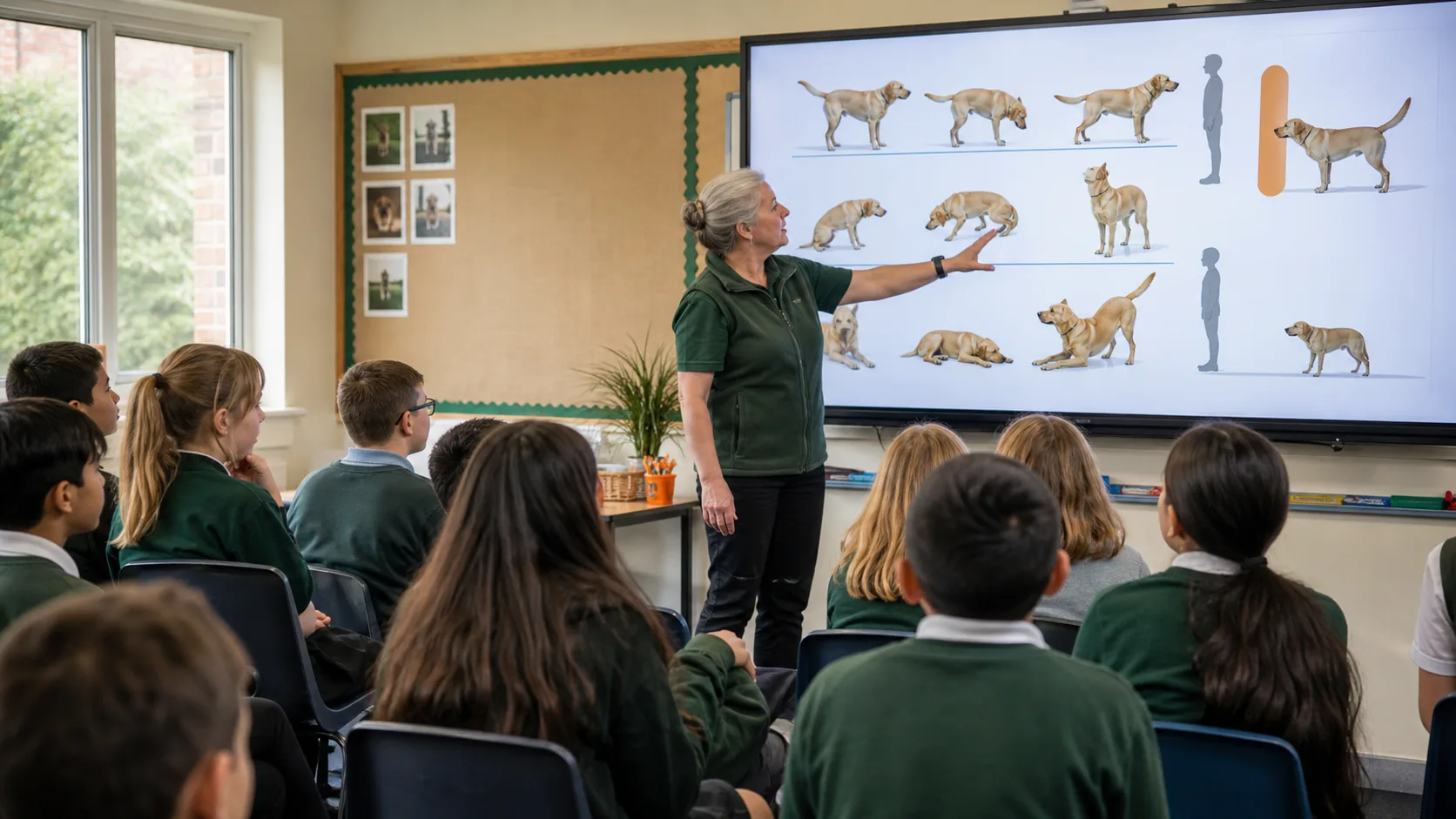
Understanding common signs of comfort, uncertainty, stress, fear, frustration and escalation before behaviour becomes more serious.
Learning when not to approach, why an owner’s permission matters and how sleep, food, toys, pain, confinement and puppies can change risk.
Memorable, age-appropriate actions for responding calmly to an unfamiliar, loose or over-excited dog and getting help from a responsible adult.
Recognising situations that need extra care around homes, parks, school gates, vehicles, fences, doorways and busy public spaces.
Building safer habits around touching, play, chasing, hugging, teasing and interrupting dogs, without placing responsibility for an adult’s dog onto a child.
Knowing how to report a concern, near miss or bite promptly, and understanding why a struggling dog needs appropriate adult and professional help.
Our educational sessions can be adapted to suit different age groups, learning needs and school environments.
Delivery can be shaped around primary, secondary, SEND, alternative provision and youth or community settings. We agree the age range, group size, format and learning priorities with the school before the session.
Bring Canine UK to your schoolDesigned session options
We confirm the format, materials and arrangements with your setting before booking.
Slides, guided activities and take home reminders support the sessions. Adults remain responsible for safety.
In your enquiry: tell us your setting, location, age range, approximate group size and any access or learning needs.
Read, practise, revisit
Our books, PDFs and activity materials live in Resources, ready to use at home or alongside a session.
For concerns about your own dog's behaviour, a Behavioural Audit is the starting point for individual support.
Owners & professionals
Owner education and practical application are central to our approach. Understanding the individual dog helps owners make informed decisions, apply training consistently and manage everyday situations with confidence.
Ask about owner educationExplore canine first aid for dog owners, professional first aid for people working with dogs, and puppy first aid, lifesaving and everyday care. Our courses combine emergency awareness with practical knowledge for the dogs you care for.
Before your session
No. Children are never exposed to an aggressive or high-risk dog as part of the course. Teaching uses age-appropriate explanation and controlled educational materials. If a suitable dog is ever included in another school activity, that would only happen following separate agreement, assessment and risk planning.
Yes. The language, examples, activities and delivery format can be shaped around the age range, group size, learning needs and setting. Staff, parent and carer education can also be discussed alongside pupil sessions.