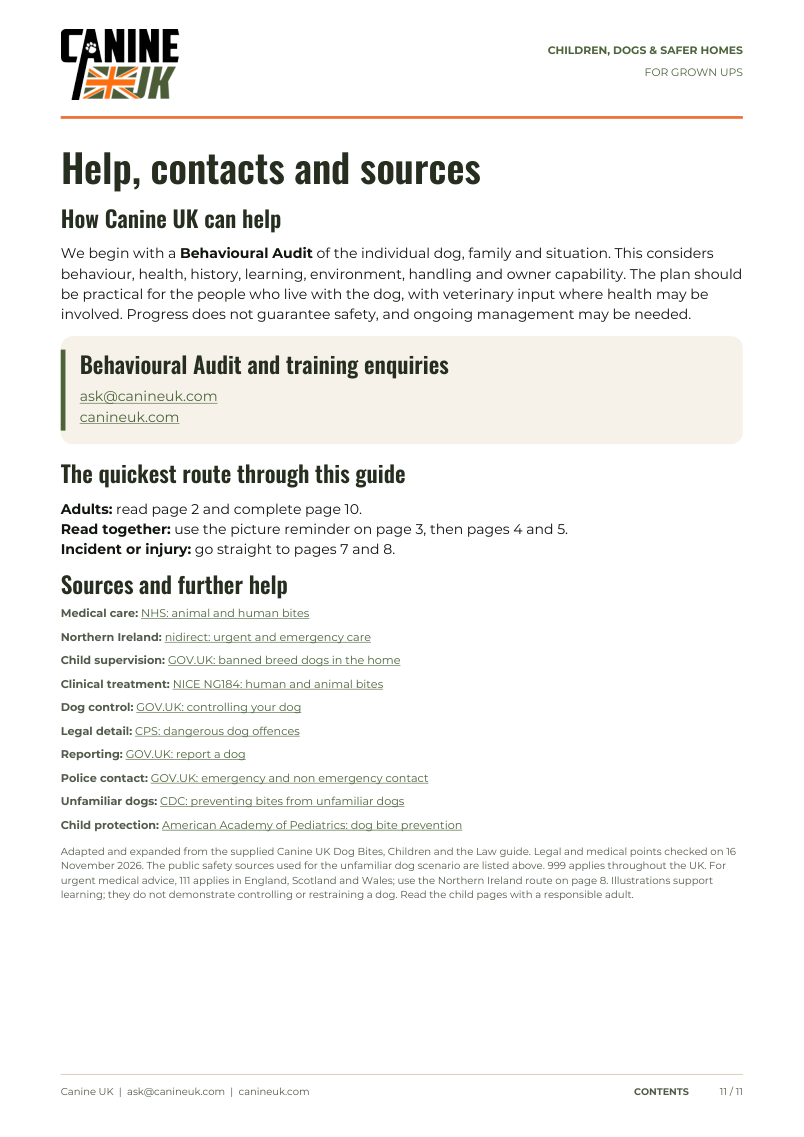
Read the complete family guide below, with illustrations alongside the practical advice.
For printing or sharing, download the 11 page PDF. Both versions include the country specific medical contacts and current England and Wales supervision guidance.
SECTION 1 OF 11
Children, dogs & safer homes
A GUIDE TO READ TOGETHER
For parents, carers and children
Practical ways to prevent bites, recognise discomfort and know what to do when something goes wrong.
Grown ups take responsibility. Children learn safe habits.
A familiar dog still needs space, thoughtful management and an adult who is paying attention.
View illustrated page 1
SECTION 2 OF 11
Everyday safety starts with adults
Children are still learning how to move, play and read a dog. It is our job to make the situation manageable, rather than expect the child or dog to get everything right.
Active supervision means being ready to act
A responsible adult watches the interaction and can end it early. Being in the same room while using a phone, cooking or looking after something else is not active supervision. Never leave a young child alone with a dog.
If your attention has to move, separate first
Set up a comfortable dog area and a child area before busy times. Use a closed, secure door or a suitable barrier the dog cannot jump or push through and the child cannot open or reach through. Keep the dog’s water, rest and welfare needs met.
Protect rest and food
Children leave sleeping, eating and crated dogs alone. They do not take bowls, chews or toys, enter a dog’s bed, or follow a dog that moves away.
Keep contact calm
No hugging, kissing, climbing, riding, chasing or cornering. Keep children’s faces away from dogs’ faces. Adults manage handling and equipment.
Plan the busy moments
Visitors, playdates, snacks, doorways and excited play need a plan. Agree who watches the dog and who looks after the children.
Make rules achievable
Use simple words and repetition. Adapt arrangements to each child’s age, mobility, understanding and sensory needs. Rules cannot replace supervision.
A known bite risk needs more than “watching closely”
Keep secure separation where there has been a bite, threatening behaviour or a near miss involving a child, while a Behavioural Audit and individual safety plan are arranged. A child must never be used to test the dog or practise a risky exercise.
A dog can be part of family life without sharing every activity or accepting every interaction.
View illustrated page 2
SECTION 3 OF 11
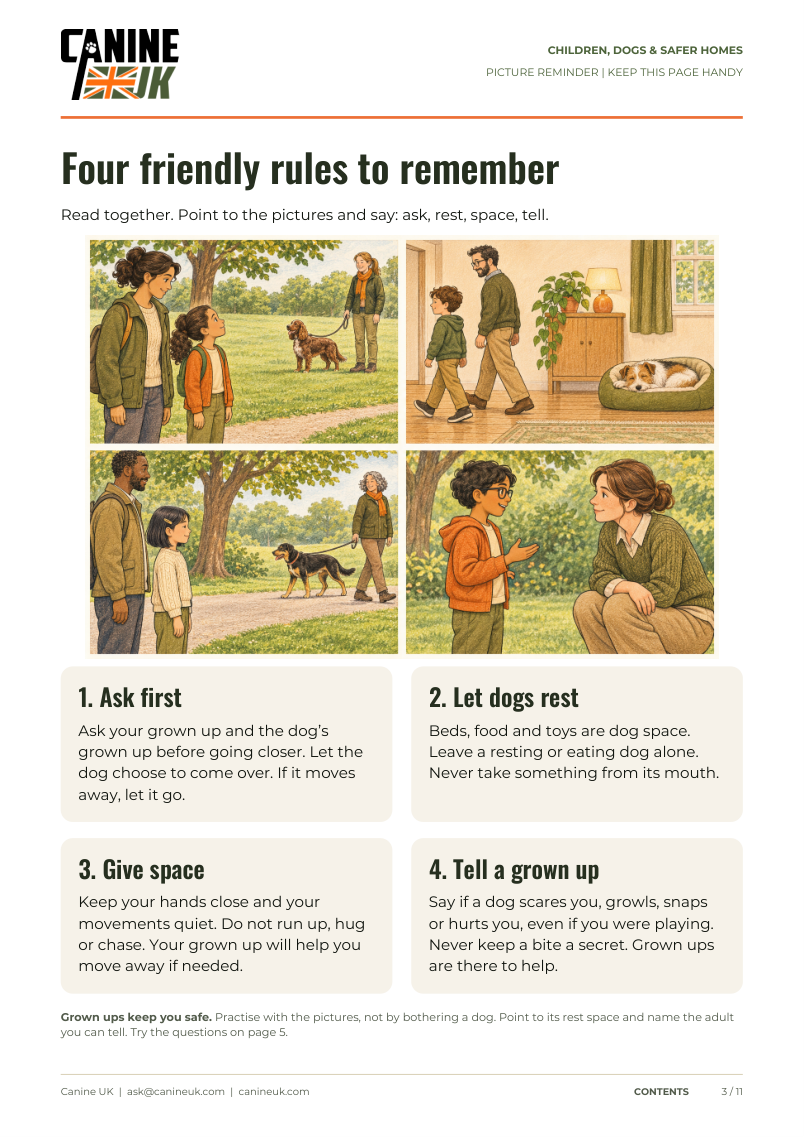
Four friendly rules to remember
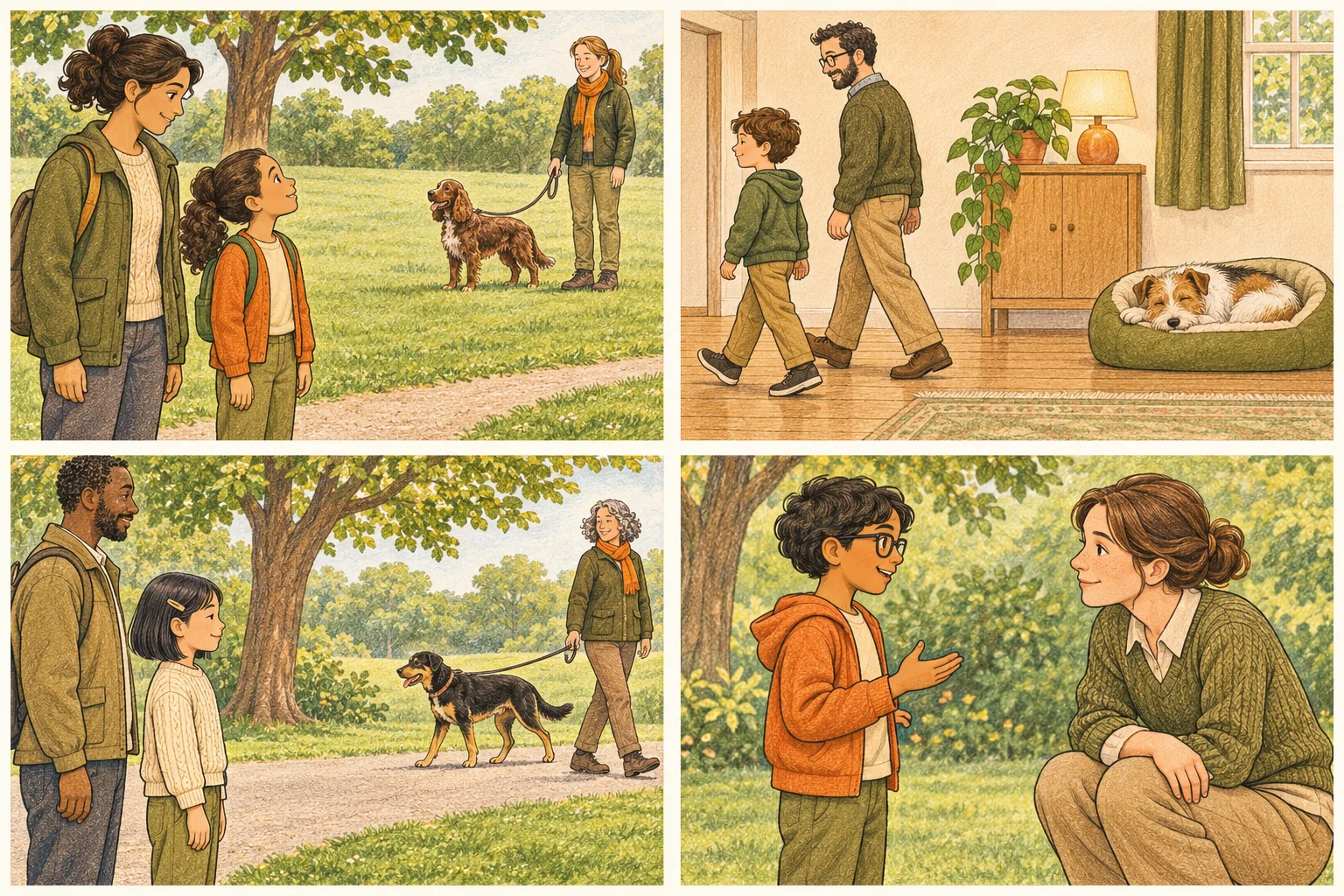
Read together. Point to the pictures and say: ask, rest, space, tell.
1. Ask first
Ask your grown up and the dog’s grown up before going closer. Let the dog choose to come over. If it moves away, let it go.
2. Let dogs rest
Beds, food and toys are dog space. Leave a resting or eating dog alone. Never take something from its mouth.
3. Give space
Keep your hands close and your movements quiet. Do not run up, hug or chase. Your grown up will help you move away if needed.
4. Tell a grown up
Say if a dog scares you, growls, snaps or hurts you, even if you were playing. Never keep a bite a secret. Grown ups are there to help.
Grown ups keep you safe. Practise with the pictures, not by bothering a dog. Point to its rest space and name the adult you can tell. Try the questions on page 5.
View illustrated page 3
SECTION 4 OF 11
If an unfamiliar dog comes towards you
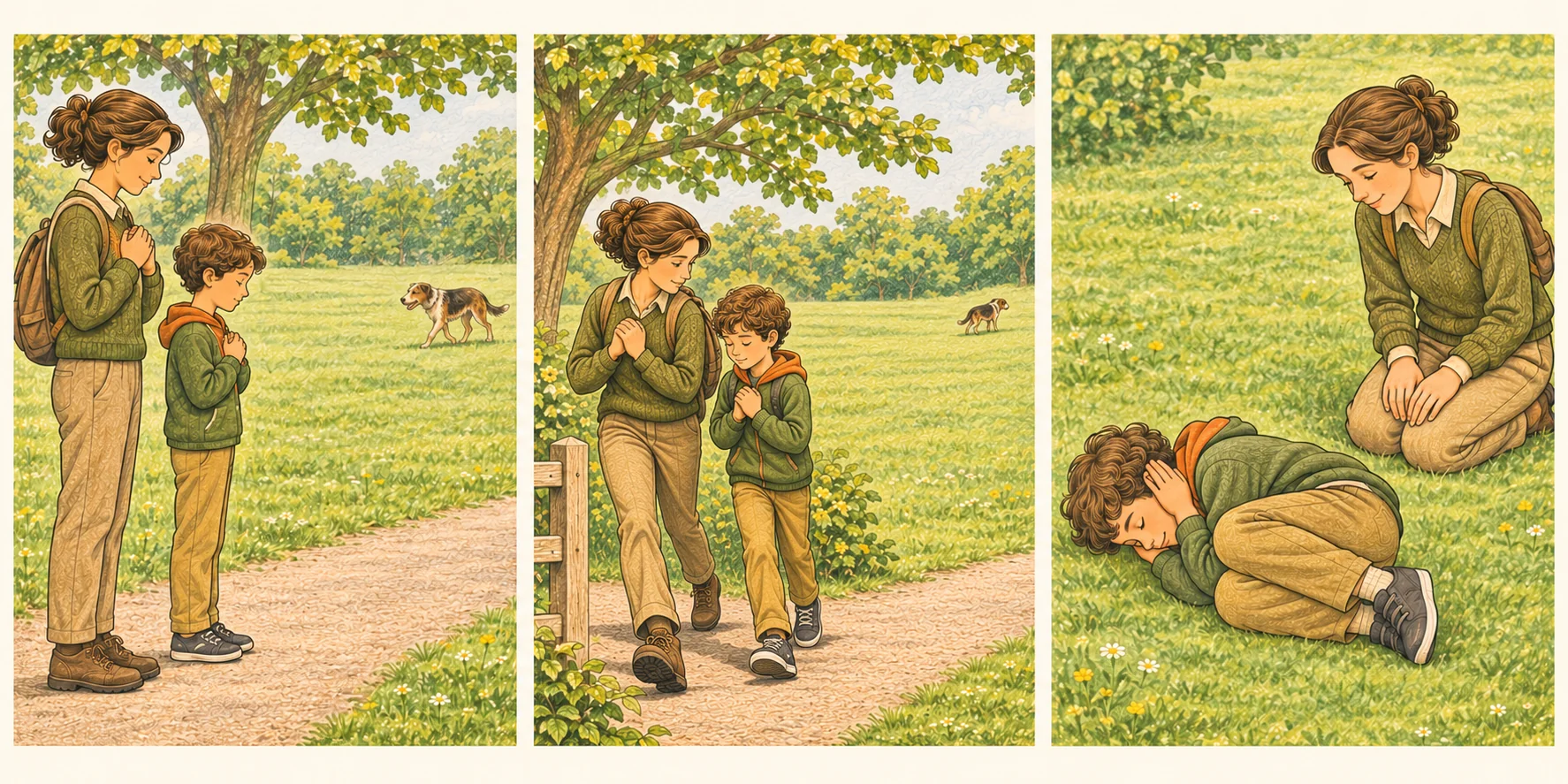
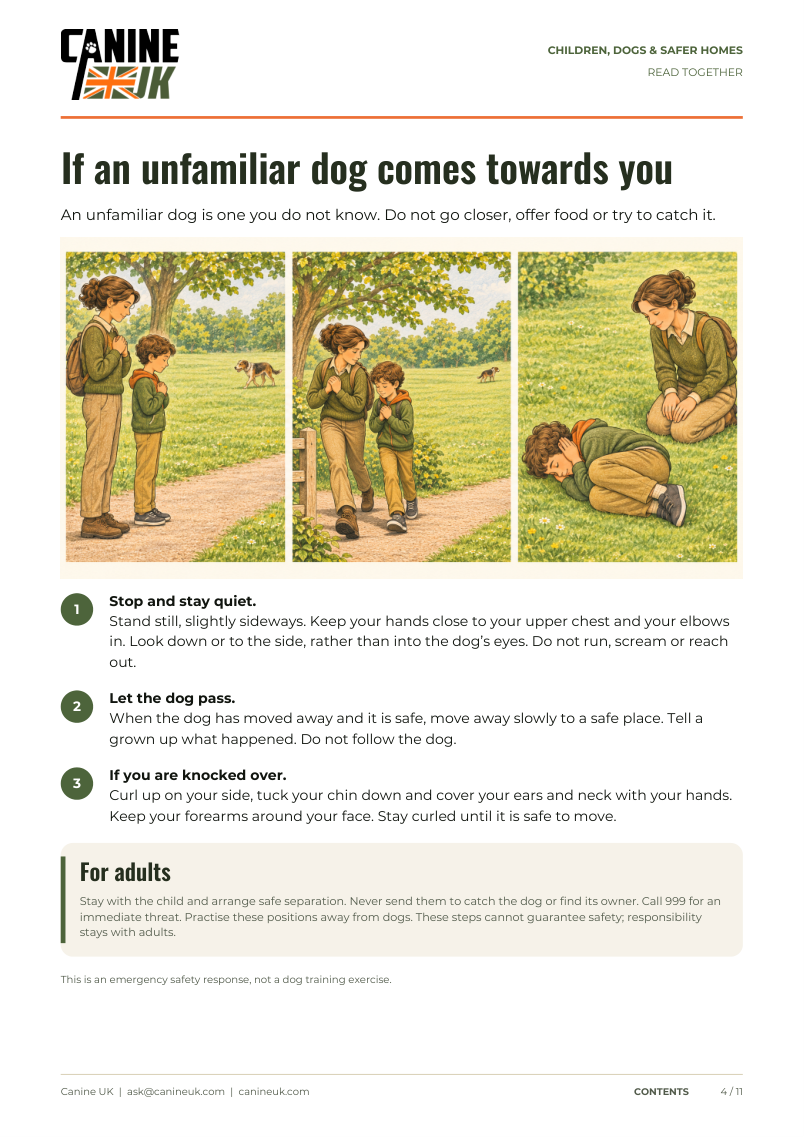
An unfamiliar dog is one you do not know. Do not go closer, offer food or try to catch it.
1. Stop and stay quiet.
Stand still, slightly sideways. Keep your hands close to your upper chest and your elbows in. Look down or to the side, rather than into the dog’s eyes. Do not run, scream or reach out.
2. Let the dog pass.
When the dog has moved away and it is safe, move away slowly to a safe place. Tell a grown up what happened. Do not follow the dog.
3. If you are knocked over.
Curl up on your side, tuck your chin down and cover your ears and neck with your hands. Keep your forearms around your face. Stay curled until it is safe to move.
For adults
Stay with the child and arrange safe separation. Never send them to catch the dog or find its owner. Call 999 for an immediate threat. Practise these positions away from dogs. These steps cannot guarantee safety; responsibility stays with adults.
This is an emergency safety response, not a dog training exercise.
View illustrated page 4
SECTION 5 OF 11
What would you do?
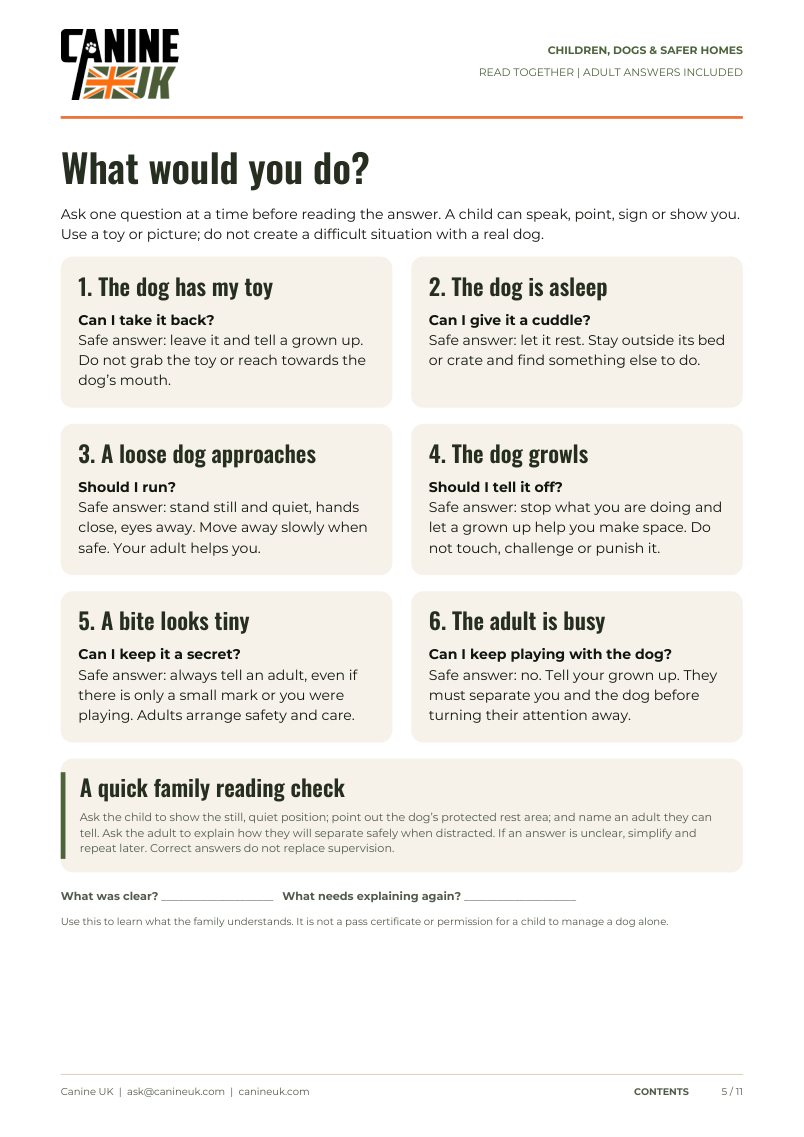
Ask one question at a time before reading the answer. A child can speak, point, sign or show you. Use a toy or picture; do not create a difficult situation with a real dog.
1. The dog has my toy
Can I take it back? Safe answer: leave it and tell a grown up. Do not grab the toy or reach towards the dog’s mouth.
2. The dog is asleep
Can I give it a cuddle? Safe answer: let it rest. Stay outside its bed or crate and find something else to do.
3. A loose dog approaches
Should I run? Safe answer: stand still and quiet, hands close, eyes away. Move away slowly when safe. Your adult helps you.
4. The dog growls
Should I tell it off? Safe answer: stop what you are doing and let a grown up help you make space. Do not touch, challenge or punish it.
5. A bite looks tiny
Can I keep it a secret? Safe answer: always tell an adult, even if there is only a small mark or you were playing. Adults arrange safety and care.
6. The adult is busy
Can I keep playing with the dog? Safe answer: no. Tell your grown up. They must separate you and the dog before turning their attention away.
A quick family reading check
Ask the child to show the still, quiet position; point out the dog’s protected rest area; and name an adult they can tell. Ask the adult to explain how they will separate safely when distracted. If an answer is unclear, simplify and repeat later. Correct answers do not replace supervision.
What was clear? ____________________ What needs explaining again? ____________________
Use this to learn what the family understands. It is not a pass certificate or permission for a child to manage a dog alone.
View illustrated page 5
SECTION 6 OF 11
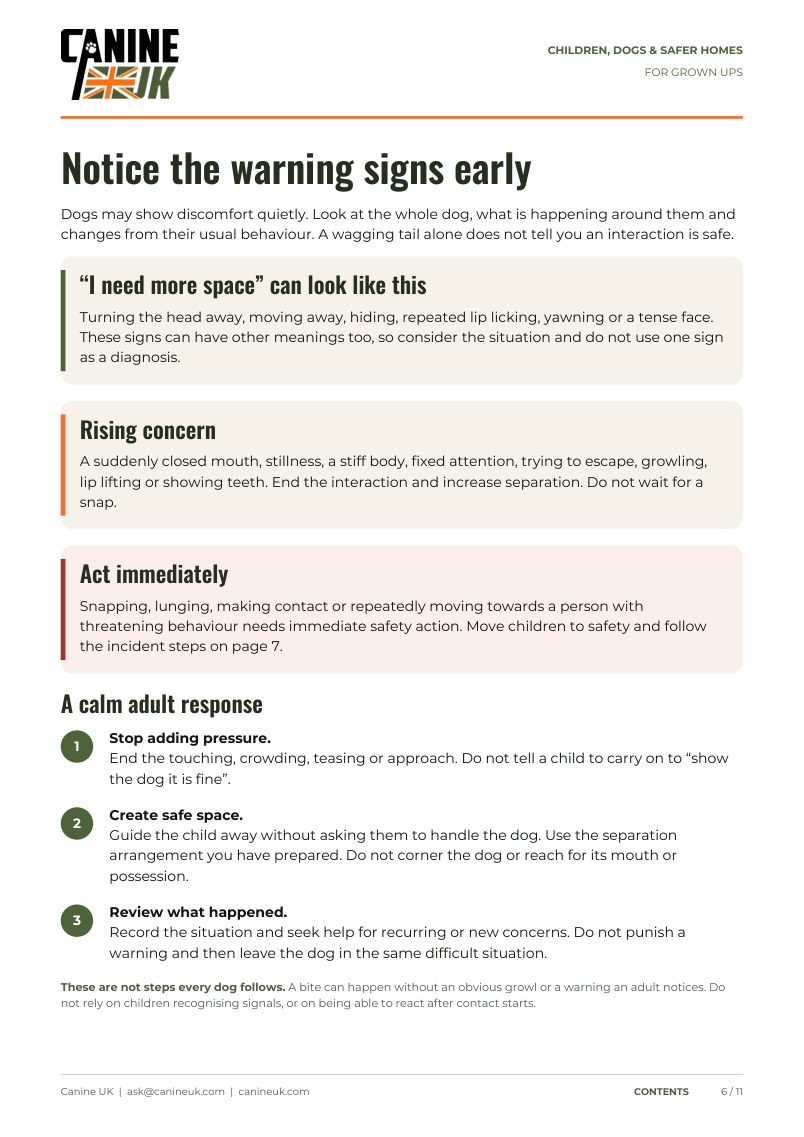
Notice the warning signs
Dogs may show discomfort quietly. Look at the whole dog, what is happening around them and changes from their usual behaviour. A wagging tail alone does not tell you an interaction is safe.
“I need more space” can look like this
Turning the head away, moving away, hiding, repeated lip licking, yawning or a tense face. These signs can have other meanings too, so consider the situation and do not use one sign as a diagnosis.
Rising concern
A suddenly closed mouth, stillness, a stiff body, fixed attention, trying to escape, growling, lip lifting or showing teeth. End the interaction and increase separation. Do not wait for a snap.
Act immediately
Snapping, lunging, making contact or repeatedly moving towards a person with threatening behaviour needs immediate safety action. Move children to safety and follow the incident steps on page 7.
A calm adult response
1. Stop adding pressure.
End the touching, crowding, teasing or approach. Do not tell a child to carry on to “show the dog it is fine”.
2. Create safe space.
Guide the child away without asking them to handle the dog. Use the separation arrangement you have prepared. Do not corner the dog or reach for its mouth or possession.
3. Review what happened.
Record the situation and seek help for recurring or new concerns. Do not punish a warning and then leave the dog in the same difficult situation.
These are not steps every dog follows. A bite can happen without an obvious growl or a warning an adult notices. Do not rely on children recognising signals, or on being able to react after contact starts.
View illustrated page 6
SECTION 7 OF 11
If an incident happens
Medical contacts: 111 here means England, Scotland and Wales. See the Northern Ireland route. Call 999 for an emergency anywhere in the UK.
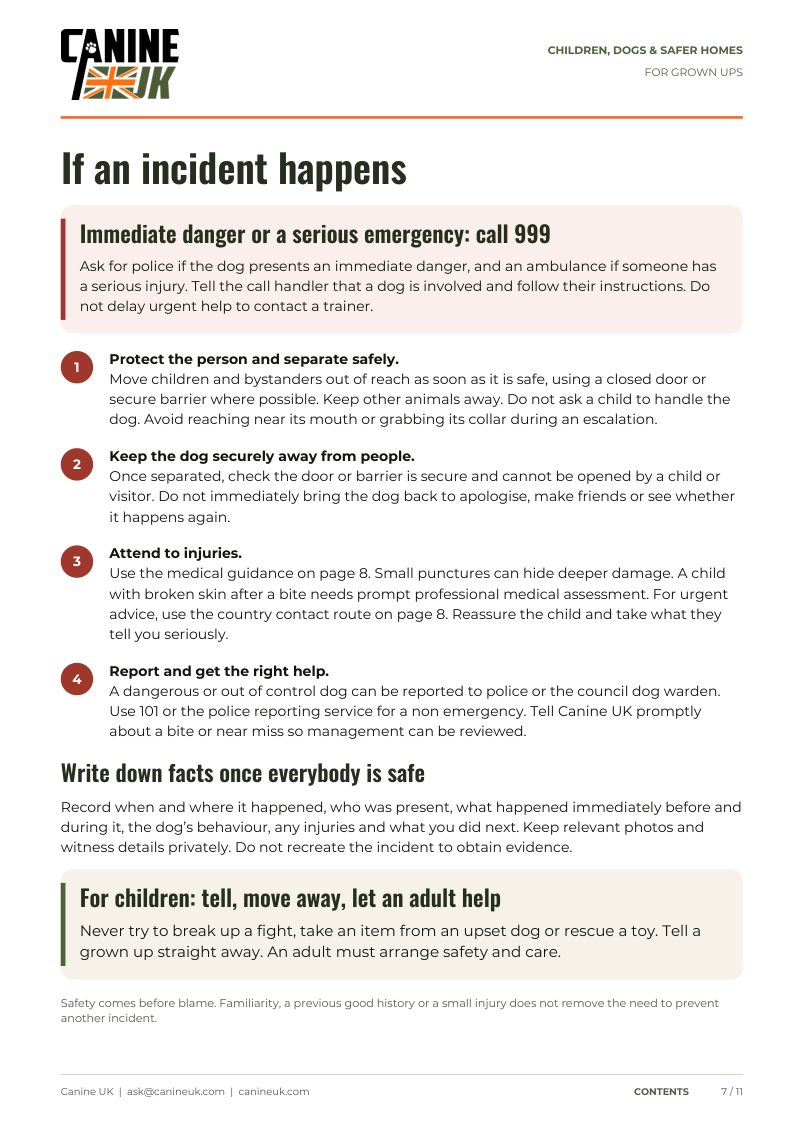
Immediate danger or a serious emergency: call 999
Ask for police if the dog presents an immediate danger, and an ambulance if someone has a serious injury. Tell the call handler that a dog is involved and follow their instructions. Do not delay urgent help to contact a trainer.
1. Protect the person and separate safely.
Move children and bystanders out of reach as soon as it is safe, using a closed door or secure barrier where possible. Keep other animals away. Do not ask a child to handle the dog. Avoid reaching near its mouth or grabbing its collar during an escalation.
2. Keep the dog securely away from people.
Once separated, check the door or barrier is secure and cannot be opened by a child or visitor. Do not immediately bring the dog back to apologise, make friends or see whether it happens again.
3. Attend to injuries.
Use the medical guidance on page 8. Small punctures can hide deeper damage. A child with broken skin after a bite needs prompt professional medical assessment. If unsure, use the country specific urgent advice on page 8. Reassure the child and take what they tell you seriously.
4. Report and get the right help.
A dangerous or out of control dog can be reported to police or the council dog warden. Use 101 or the police reporting service for a non emergency. Tell Canine UK promptly about a bite or near miss so management can be reviewed.
Write down facts once everybody is safe
Record when and where it happened, who was present, what happened immediately before and during it, the dog’s behaviour, any injuries and what you did next. Keep relevant photos and witness details privately. Do not recreate the incident to obtain evidence.
For children: tell, move away, let an adult help
Never try to break up a fight, take an item from an upset dog or rescue a toy. Tell a grown up straight away. An adult must arrange safety and care.
Safety comes before blame. Familiarity, a previous good history or a small injury does not remove the need to prevent another incident.
View illustrated page 7
SECTION 8 OF 11
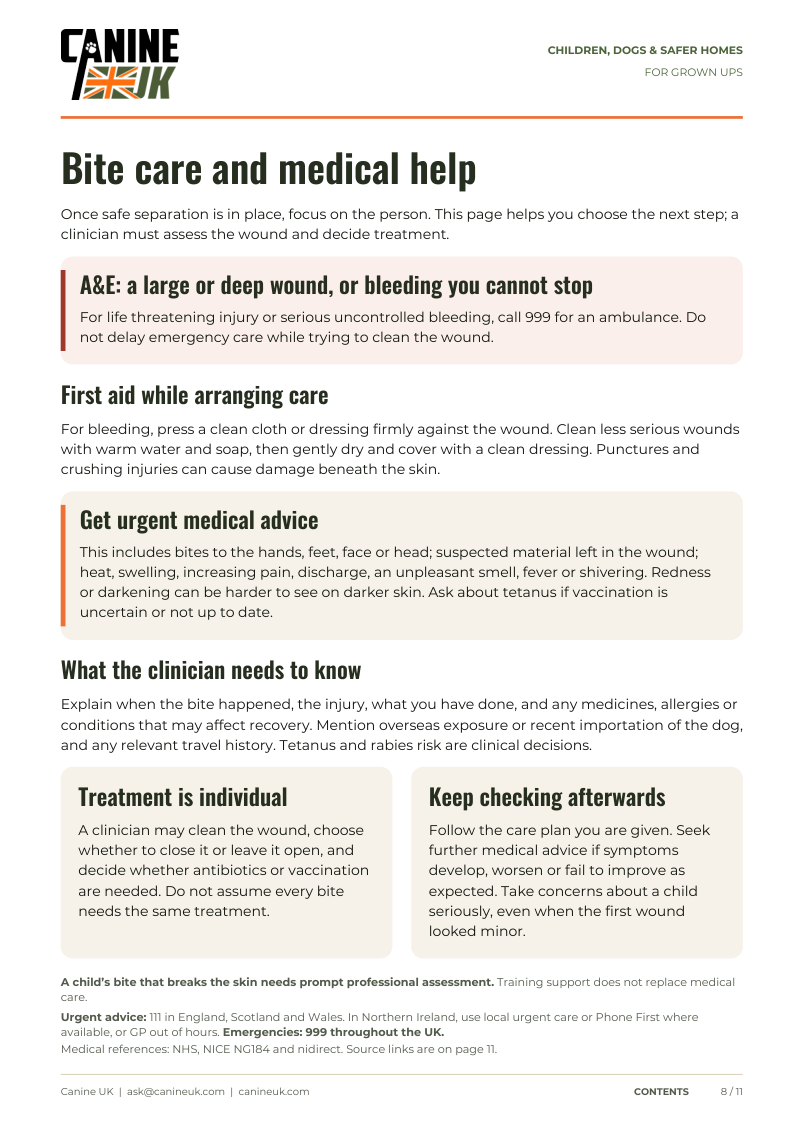
Bite care and medical help
Urgent advice: call 111 in England, Scotland or Wales. In Northern Ireland, use local urgent care or Phone First where available, or GP out of hours. For life threatening emergencies, call 999 anywhere in the UK.
Medical contacts: 111 here means England, Scotland and Wales. See the Northern Ireland route. Call 999 for an emergency anywhere in the UK.
Once safe separation is in place, focus on the person. This page helps you choose the next step; a clinician must assess the wound and decide treatment.
A&E: a large or deep wound, or bleeding you cannot stop
For life threatening injury or serious uncontrolled bleeding, call 999 for an ambulance. Do not delay emergency care while trying to clean the wound.
First aid while arranging care
For bleeding, press a clean cloth or dressing firmly against the wound. Clean less serious wounds with warm water and soap, then gently dry and cover with a clean dressing. Punctures and crushing injuries can cause damage beneath the skin.
Get urgent medical advice in England, Scotland and Wales
This includes bites to the hands, feet, face or head; suspected material left in the wound; heat, swelling, increasing pain, discharge, an unpleasant smell, fever or shivering. Redness or darkening can be harder to see on darker skin. Ask about tetanus if vaccination is uncertain or not up to date.
What the clinician needs to know
Explain when the bite happened, the injury, what you have done, and any medicines, allergies or conditions that may affect recovery. Mention overseas exposure or recent importation of the dog, and any relevant travel history. Tetanus and rabies risk are clinical decisions.
Treatment is individual
A clinician may clean the wound, choose whether to close it or leave it open, and decide whether antibiotics or vaccination are needed. Do not assume every bite needs the same treatment.
Keep checking afterwards
Follow the care plan you are given. Seek further medical advice if symptoms develop, worsen or fail to improve as expected. Take concerns about a child seriously, even when the first wound looked minor.
A child’s bite that breaks the skin needs prompt professional assessment. Training support does not replace medical care.
Medical references: NHS animal and human bites; NICE NG184. Click the source links on page 11.
View illustrated page 8
SECTION 9 OF 11
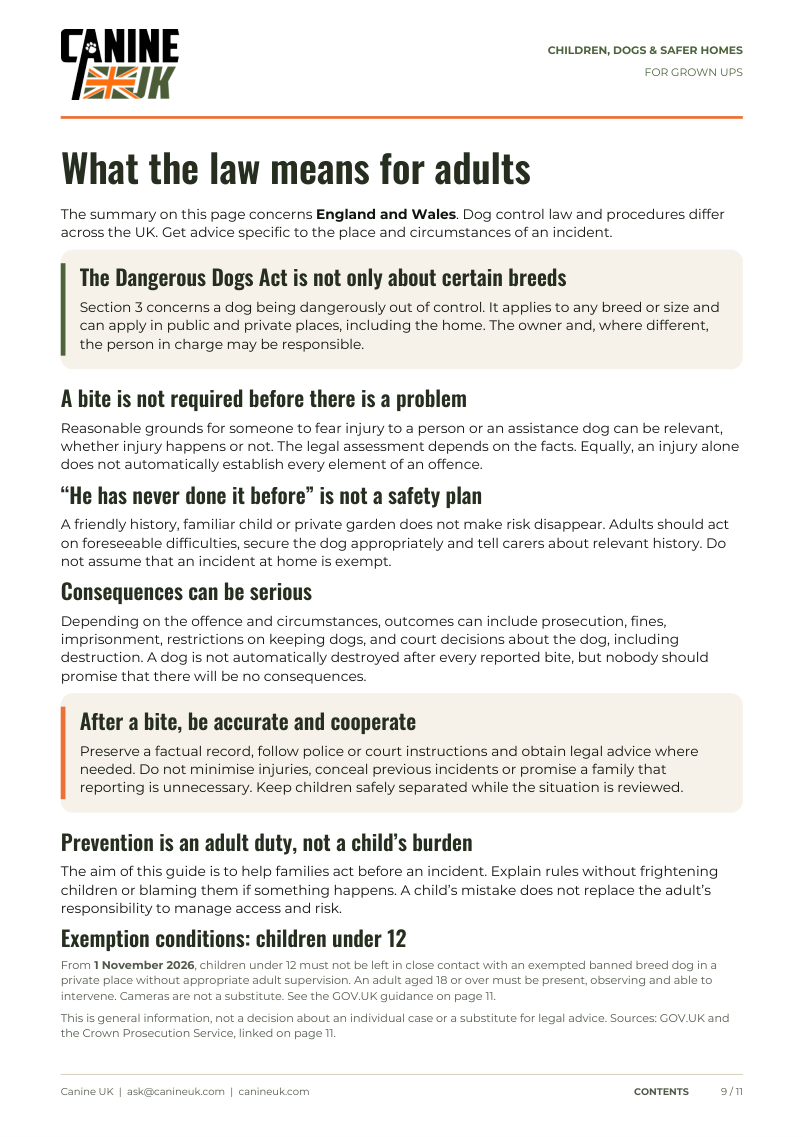
What the law means
The summary on this page concerns England and Wales. Dog control law and procedures differ across the UK. Get advice specific to the place and circumstances of an incident.
The Dangerous Dogs Act is not only about certain breeds
Section 3 concerns a dog being dangerously out of control. It applies to any breed or size and can apply in public and private places, including the home. The owner and, where different, the person in charge may be responsible.
A bite is not required before there is a problem
Reasonable grounds for someone to fear injury to a person or an assistance dog can be relevant, whether injury happens or not. The legal assessment depends on the facts. Equally, an injury alone does not automatically establish every element of an offence.
“He has never done it before” is not a safety plan
A friendly history, familiar child or private garden does not make risk disappear. Adults should act on foreseeable difficulties, secure the dog appropriately and tell carers about relevant history. Do not assume that an incident at home is exempt.
Consequences can be serious
Depending on the offence and circumstances, outcomes can include prosecution, fines, imprisonment, restrictions on keeping dogs, and court decisions about the dog, including destruction. A dog is not automatically destroyed after every reported bite, but nobody should promise that there will be no consequences.
After a bite, be accurate and cooperate
Preserve a factual record, follow police or court instructions and obtain legal advice where needed. Do not minimise injuries, conceal previous incidents or promise a family that reporting is unnecessary. Keep children safely separated while the situation is reviewed.
Prevention is an adult duty, not a child’s burden
The aim of this guide is to help families act before an incident. Explain rules without frightening children or blaming them if something happens. A child’s mistake does not replace the adult’s responsibility to manage access and risk.
This is general information, not a decision about an individual case or a substitute for legal advice. Sources: GOV.UK and the Crown Prosecution Service, linked on page 11.
View illustrated page 9
SECTION 10 OF 11
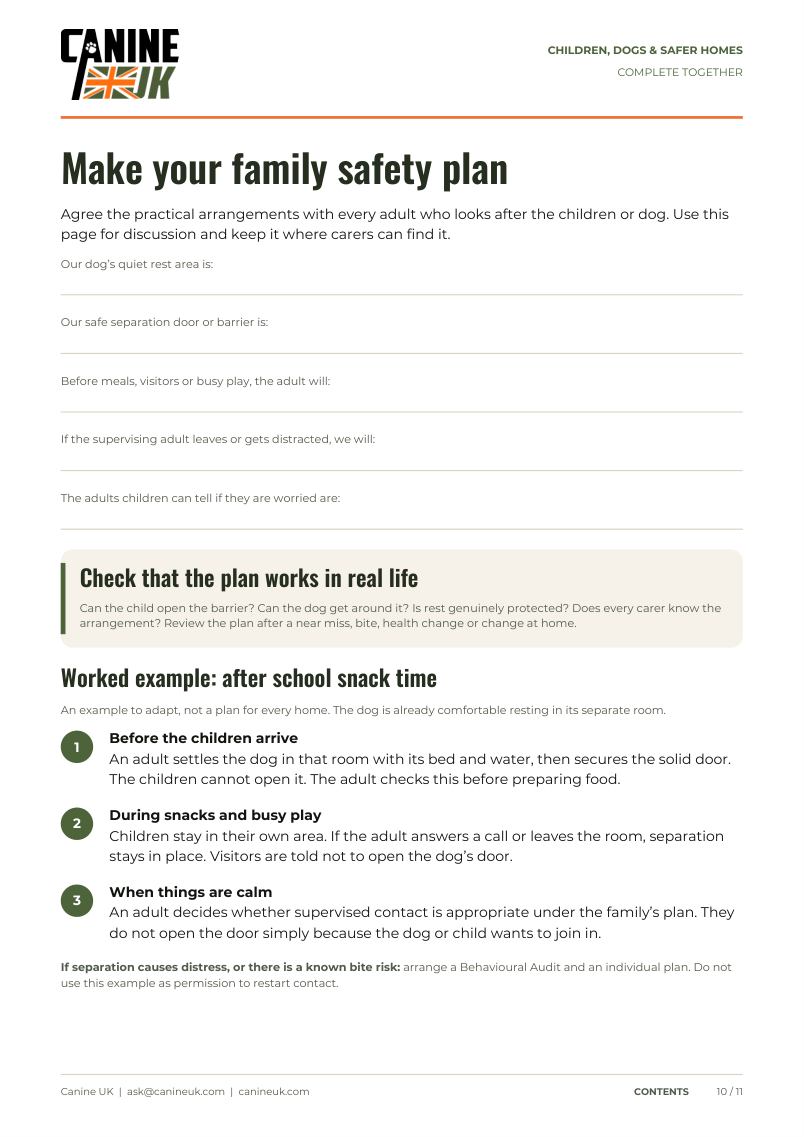
Your family plan and example
Agree the practical arrangements with every adult who looks after the children or dog. Use this page for discussion and keep it where carers can find it.
Our dog’s quiet rest area is:
Our safe separation door or barrier is:
Before meals, visitors or busy play, the adult will:
If the supervising adult leaves or gets distracted, we will:
The adults children can tell if they are worried are:
Check that the plan works in real life
Can the child open the barrier? Can the dog get around it? Is rest genuinely protected? Does every carer know the arrangement? Review the plan after a near miss, bite, health change or change at home.
Worked example: after school snack time
An example to adapt, not a plan for every home. The dog is already comfortable resting in its separate room.
1. Before the children arrive An adult settles the dog in that room with its bed and water, then secures the solid door.
The children cannot open it. The adult checks this before preparing food.
2. During snacks and busy play Children stay in their own area.
If the adult answers a call or leaves the room, separation stays in place. Visitors are told not to open the dog’s door.
3. When things are calm An adult decides whether supervised contact is appropriate under the family’s plan.
They do not open the door simply because the dog or child wants to join in.
If separation causes distress, or there is a known bite risk: arrange a Behavioural Audit and an individual plan. Do not use this example as permission to restart contact.
View illustrated page 10
SECTION 11 OF 11
Help, contacts and sources
Medical contacts: 111 here means England, Scotland and Wales. See the Northern Ireland route. Call 999 for an emergency anywhere in the UK.
How Canine UK can help
We begin with a Behavioural Audit of the individual dog, family and situation. This considers behaviour, health, history, learning, environment, handling and owner capability. The plan should be practical for the people who live with the dog, with veterinary input where health may be involved. Progress does not guarantee safety, and ongoing management may be needed.
Behavioural Audit and training enquiries
ask@canineuk.com canineuk.com
The quickest route through this guide
Adults: read page 2 and complete page 10. Read together: use the picture reminder on page 3, then pages 4 and 5. Incident or injury: go straight to pages 7 and 8.
Sources and further help
Medical care: NHS: animal and human bites
Clinical treatment: NICE NG184: human and animal bites
Dog control: GOV.UK: controlling your dog
Legal detail: CPS: dangerous dog offences
Reporting: GOV.UK: report a dog
Police contact: GOV.UK: emergency and non emergency contact
Unfamiliar dogs: CDC: preventing bites from unfamiliar dogs
Child protection: American Academy of Pediatrics: dog bite prevention
Adapted and expanded from the supplied Canine UK Dog Bites, Children and the Law guide. Legal and medical contact updates checked on 16 November 2026. The public safety sources used for the unfamiliar dog scenario are listed above. UK emergency contacts apply throughout the UK. The 111 route here is for England, Scotland and Wales; see the medical contact note for Northern Ireland. Illustrations support learning; they do not demonstrate controlling or restraining a dog. Read the child pages with a responsible adult.
View illustrated page 11